

I recently made the decision to explore equine-assisted psychotherapy. I love my career as a psychotherapist, but I have felt like there is an essential element I’ve been missing. Therapy is an incredible experience, but sometimes people need more. It isn’t enough to sit and talk about the difficulties that life throws at our feet. It isn’t enough to negotiate how to manage chores and finances in a marriage, to talk about how the affair can be healed, or how to find emotional regulation after the miscarriage or cancer diagnosis. There has been something missing.
Horses and dogs have been my personal therapy since I was a child. I had the good fortune to be able to jump on a horse and gallop away into the fields when I needed to escape. I remember one summer I rode six different horses nearly every day. It was primarily to keep up their fitness and training, but it served me just as much as it served them. I didn’t realize it it at the time, but they had become my emotional regulators and my place of safety and recuperation. They had become the only place where I could escape social pressures, adolescent difficulties, and most importantly, my own swirling thoughts and anxieties. In my practice I sit with people in pain hour after hour, and orient myself to their difficult realities. I hear about the traumas that torment their thought and dreams, their failing marriages, their crippling fears, and their manipulative and narcissistic parents/spouses/bosses/friends. I have found that the optimal way to clear my mind and recharge is to drive straight to the stables where it is just me, the horses, the smells of leather and hay, and the freedom to connect deeply with a horse without hearing a word from them.
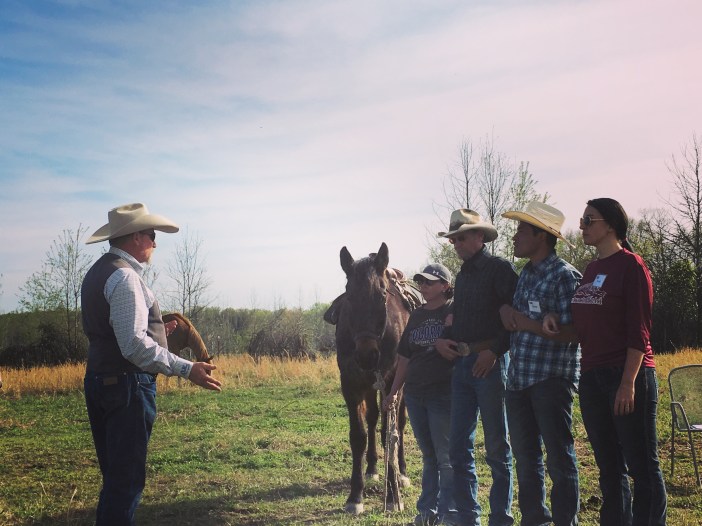
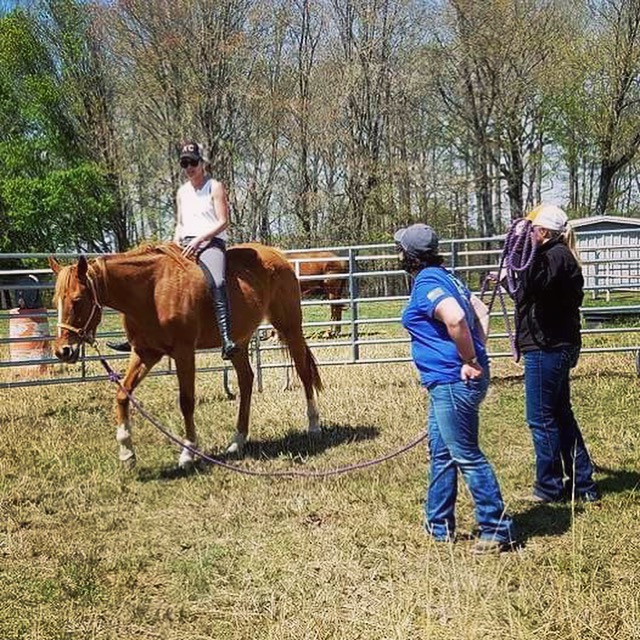
I researched models and had a lovely conversation with the founder of equine-assisted psychotherapy, and chose his certification over other models. His name is Greg Kersten, and he has found the dynamics of herds of horses to be powerfully metaphorical to how us humans get ourselves stuck. He has a grassroots program that is clear, uncomplicated, and effective. This program has been implemented with prisoners, troubled adolescents, celebrity and non-celebrity addictions, veteran programs, couples, families, and more. People walk away with profound insight and strong initiative to implement change their lives. For three days we sat outside in pastures among a herd of horses and observed the herd dynamics. We engaged in exercises where we were to figure out how to execute a task, such as haltering or longeing a horse, complete an obstacle course, and communicate to someone who to saddle a horse using only words and no gestures or illustration. Some had very little experience or none at all with these tasks, but they bravely performed them in front of the group. There are endless metaphors in these simple exercises, and I was amazed at how working with the horses gave us glimpses into the problems in our current lives/lifestyles. Big emotions came up but were managed and overcome. Anxities were acknowledged and put in check. Shame was reckoned with and tasks were completed, and there was no failure. I brought back many concepts from the herd dynamic, and can see a more organic and less complicated lifestyle ahead. Read on if the idea of simplicity, clarity, and balance is seductive for you as well!

Greg taught us his principles of pressure/pain response, attention vs. at ease, and congruent communication. The principles are his intellectual property and were formed from years of observation. I’ve taken them and expanded upon how they relate to our everyday lives.
Lessons learned from observing herd dynamics and in working with the equine-human connection:
1. Horses need for our communication to them to be congruent, this is crucial for building trust. They don’t care about our promises or best intentions, they respond to how we actually are in the moment. Our verbal and non-verbal communication must be delivering the same message. You can’t be agitated and expect the horse to respond to you calmly. Greg told a story where he was in a hurry to go get his horse, and had a hard time catching him. Someone said, “you looked so angry out there!” Greg said that he wasn’t mad at all, just in a hurry to ride. What he realized is that horses don’t understand the difference between a hurry and anger. They interpret our body language and don’t trust us if our calls to “come here” are not congruent with the pace we’re moving at, the volume and intonation in our voice, and the impression our body is giving them.
This is where humans can learn benefit from the dynamics of herd animals. Horses don’t take it upon themselves to figure out the difference between angry and hurry, they need for us to be clear with our message! Horses don’t communicate with each other with opaque messages, ambiguity or manipulative undertones. They are clear and consistent, and this keeps the herd connected and functional. We want people to trust us, but we’re sending opposing messages. How often have you said yes to something when you want too say no? How often do you volunteer your time or abilities when you don’t want to, don’t have time to or don’t have the ability to, and find yourself resentful? Getting clear and saying no actually builds trust in relationships. I want to know that if I ask a friend to let my dogs out, that their yes means yes and I don’t have to worry about how I can reciprocate or feel bad for asking. I want to know that if my husband offers to do something for me that he means it and I don’t have to question why he’s doing it and what his endgame is. I want to trust people when they say yes, and I will trust them when I know they are able and willing to say no.
2. Horses moved way from pressure and move in to pain. We tend to do the opposite! I adopted two mini horses last month, and one of them, Cash, was the boss-man at his barn. We integrated them into a new herd, and pretty soon Cash was getting his rear end kicked (literally) by the herd leader. As he was getting repeatedly kicked, I noticed that he wasn’t moving away, he was moving IN to the repeated blows! He intuitively knew that if he moved away, he’d be hurt worse and the threat would follow. We have learned from this principle that we are much safer if we’re very close to the hind quarters of a horse than we are at 3 feet away, as the kick would have much less impact if we are near. We might have immediate pain, by by staying near we actually lessen each blow and have less long term injuries or repercussions.
We have become a culture so focused on preventing pain and maintaining safety. This is helpful in some ways, but we have lost the crucial developmental lesson of how to manage pain when it happens. We are over-protective of ourselves and our children, we are over-involved with our neighbor’s business, we try to take care of our friend and make them feel better, and we are often anxious about how we’re doing too much/too little. We have become so confident that we can avoid our own pain and fix the problems of others that we pretend we aren’t in as much pain as we actually are. As a psychotherapist, even I am not in the business of making people feel better. That is instant gratification and carries no lesson and therefore no growth. I teach clients how to lean into pain and when they can do that, they feel empowered to draw the boundaries they have known in their heart they want to draw. They get permission to be quiet, to slow down, and to stop hustling to be the perfect mom/dad/friend/daughter/son/partner/employee/boss. We have to lean into our pain and stop trying to pretend it isn’t there and that it doesn’t matter, and this is how we reduce the impact of the emotional injury. It is impossible for us to stay in an emotional state forever (anger, sadness, fear, disgust, surprise, love, shame) so we have to learn to tolerate it and lean in when it happens. If we don’t, we feel out of control and at the mercy of the world and our emotions, and become reactive and work too hard to numb.

3. Horses have mastered the balance of attention and at-ease. They know when their attention needs to be focused, and they know when they can rest and conserve energy. We have no idea how to do this! I was shocked when I watched Cash get in the fight with the leader mini horse, but even more shocked when literally five minutes later they were all grazing calmly. They didn’t retreat to plan how to manipulate or hustle or firm up their position in the hierarchy. They weren’t holding on to a dramatic emotional experience, they weren’t sulking in the corner, they weren’t drawing the other minis into the situation. They simply became at-ease because the crisis was over, and a lesson was learned. Can you imagine if we could all be as clear and consistent as horses? Horses and herds are not unpredictable. We expect the herd to establish it’s hierarchy and have conflict. We expect them to be able to manage it. We don’t get in the middle, and we allow them to experience pain and only treat it if we need to. How can we adopt this mentality in our families/neighborhoods/careers? Imagine a life where everyone worked hard to lean into their own pain, managed their anxiety, didn’t have to “vent” or involve other people into their situations. Of course, there are exceptions to this, but we are so over connected that our relationships are diluted and we don’t know when to handle our own situations or when to ask for help. We don’t handle enough of our own difficulties, we over-involve others, and in turn keep the situation alive too long and makes it much more complex. We must let people face their own pain, and be supportive but not step into theit storm. We give too much attention to our friend’s marriage and not enough to our own. We are so committed to being right and looking good that we lose the relationships that matter the most. We must learn how to properly reorient our attention, draw our boundaries, and choose very carefully what we get involved with.

4. As much as we struggle with over-attention, we struggle with being at-ease. We have become a culture that tries to fill every spare gap in the schedule with what we think are obligations. We must step back and get very honest with ourselves and ask, “where am I sacrificing what I say matters the most to me, like family and health, and giving large amounts of time and energy to things people ask/demand of me?”
At-ease doesn’t necessarily mean lounging on the couch or sleeping in. It means doing whatever you need to do to recharge and conserve your energy for the next area of focus. At-ease for some is quiet, stillness, and nature. At-ease for others is loud restaurants with friends. Only you get to decide how you can recharge, and only you will enforce that. Finding at-ease space is critical to optimal wellness for each and every one of us. This means ending the desire to please everyone and getting very clear on how what we need to be at our best.
In the first session with every client I do a little demonstration with water, where I pour water from the cup of “life” into the cup of “you.” I fill it up halfway to demonstrate normal stress around being an adult. I add big pours of water to represent the stress of the unhappy marriage, the cancer, the job pressure, the financial stress. As the cup is brimming, I add a drop to represent the PTO meeting you missed or the passive-aggressive text from a friend. The cup is so full that any drop will send you spilling over and therefore you will find yourself raging, crying, spinning in anxiety, being mean, shutting down, etcetera. The initial goal is not to reduce the water coming from the cup of life; rather, it is finding ways to be at-ease and recharge. We must lower the water level in tiny increments so that when the drops come in, we have space to handle them and not immediately spill over. When we have even a small amount of space, we can discern what we need to be focused on and what we don’t.
If any of this has you nodding your head or pining for a new level of clarity, here are some questions for you to lean into. How can you face your threats and pains, and allow yourself to return to at-ease more swiftly? How can you sensitize yourself to your levels of stress and begin to take effective respite time sooner and more often to avoid spilling over? What are the “tells” that you have been at attention for entirely too long? Who in your life brings their difficulty to your feet, and where do you bring your difficulties to the feet of others? Are you leaning into your pain and problems, or are you pretending they don’t bother you? Are you reckoning with the yucky feelings life brings to us, or are you offloading them somewhere by drinking, eating, smoking, being angry, shopping, etcetera?
It is difficult to face these questions, yet there is freedom on the other side.

 The Imperfect Therapist