
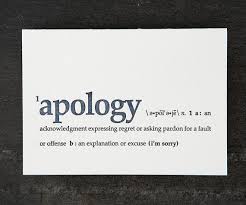
I’m SORRY.
It’s such a simple statement, with the power to be profound, yet so often it falls flat! Have you ever listened to the various politicians repent for their indiscretion on national TV and find yourself thinking, “whatever. You’re not sorry, you’re just sorry you got caught.” We see it repeatedly in the media, and we struggle to believe it and trust the person is going to be different. This also happens in relationships; marriages, long-term relationships, friendships, work relationships, and neighbors (to name a few). It becomes even trickier in relationships because most relationships struggle with communication, and poor communication is spotlighted in an apology and repair situation, and this prevents effective apology.
An effective apology and repair requires a measure of maturity and responsibility to be able to think and communicate clearly and concisely. You must be able to manage the anxieties that rise in being vulnerable with an apology and move through them. Ineffective apologies are those that fast pitch blame right back at the other person. While it’s true that often both people have contribution to the situation, the apology won’t be heard if the other person becomes defensive. Self-preservation and me-centered thinking will only communicate that your apology is to make YOU feel better instead of helping THEM feel better.
When it’s used with the appropriate insight and delivery, apology can be a very powerful experience in a relationship that actually builds trust and resiliency in a relationship. Whether you’re the offender or the offended, understanding the dynamics of effective apology and repair will help you grow from the painful experiences you’ve had or inflicted. Let’s dive in.
1. I’m sorry for ______.
A general apology will not advance you towards healing. You have to know what you’re sorry for and communicate that to your partner. The apology must be clear, and it must be fierce! You must be prepared to state out loud what you’ve done wrong. If this imperative part of the apology is skipped, the offended party will not be able to trust that you’re taking this seriously and that you will do your best to not do it again. Instead of “I’m sorry for last night, I was in a bad mood,” you need to be specific. A more effective apology includes a clear statement of what it was you’re sorry for and can sound like this:
“I realize that my bad mood and my rude statements to you at the party last night were hurtful. It is never okay to call you a name or make degrading statements to you, and I know that.” Do you hear the humility in the statement? It’s essential to effective repair. A proper apology privileges the relationship over your own personal discomfort and pride.
2. I’m sorry because ________.
This is where we have to acknowledge the impact of our behavior on the person we’re apologizing to, and we must take responsibility for our actions. Without this crucial piece we can not ask people to trust that this won’t happen again. I work with several marriages that have experienced affairs. When the offending person doesn’t acknowledge the deep and painful emotions of the other person, we can’t ask them to trust and heal. Without this acknowledgement they feel unheard, uncared for, and will land in anger and resentment instead of a mindset that could allow healing. We must acknowledge the boundary or the value that was crossed.
- Why was it wrong?
- How did you hurt the other person?
- What does the other person have to deal with as a result of your actions?
These acknowledgements are vulnerable and uncomfortable, yet essential to create an environment that can foster healing and growth.
3. In the future I will ______.
You’ve acknowledged what happened that was hurtful. You’ve acknowledged the other person’s feelings and experience. Now it’s time to seal the deal with a statement about WHY they can trust that you won’t do this again. First of all, you have to full intend to carry this out. If you don’t intend to uphold your statement then your apology is fraudulent and will create a new wound in and of itself. If you’ve identified the value or boundary that was violated , this is where you make it clear that that value is important to you. Let’s use an affair situation as an example. It is not as simple as “I won’t betray you again.” A more effective repair for a deep betrayal comes after a good amount of time dedicated to understanding the impact, and a personal decision to never hurt that person again. It sounds like:
“I realize now that I haven’t been okay for awhile. I realize that I didn’t know what to do to feel better, and in that skewed mindset, I became vulnerable to an affair. Now that I’ve learned more about myself and have accessed feelings that I’ve been suppressing for years, I’m realizing the full extent of my actions on my family and I’m devastated that I did this to you. I value our family and I value trust, and every decision I make moving forward will be through that lens. Please know that I will be taking my emotional pulse often and will do ____ (talk to you, talk to our friend, attend therapy, etc.) when I sense I’m not ok so that I never lose track of myself again.”
When the offense is serious like a betrayal of some sort, an addiction, or abuse, the “in the future” statement must be coupled with accountability. When a partner can’t trust that you can be accountable to them, a third party can be helpful As a therapist I play that role for some. When they struggle they come to see me, we talk it through, and they become accountable to me. We address the anxieties and problems while they’re manageable before they become gigantic problems that lead to poor decisons.
As an apologizer, you must also understand that the person can’t be expected to let go of their anger or hurt right away. They most likely won’t be able to trust in you right away. You must be dedicated to your apology and remind your partner of your remorse and your commitment if the offense is deep. You must also uphold your apology by being in control of yourself, reminding the other person that they are safe, and living out the values you claim.
Go forth, get vulnerable, repair, and love one another!

 The Imperfect Therapist